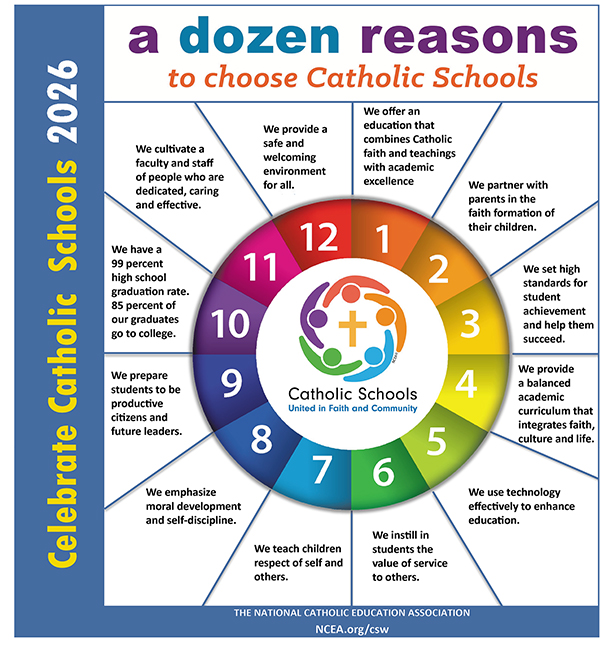





January 28, 2026 By Sister Ellen Rose Coughlin, SSJ Catholic schools across the nation celebrate their mission during Catholic Schools Week. Our Catholic schools join in the celebration. Some diocesan schools celebrate CSW during the national celebration which begins the last Sunday of January and extends throughout the week. Some schools wait until February or March and join their celebration to marketing and recruitment efforts for the following academic year. Whenever it is celebrated, schools conduct open houses and other activities for students, families, parishioners and community members. Through these events, schools focus on the mission of Catholic schools and the value Catholic education provides to young people and its contribution to the Church, the local community and the communities of our nation. A Conversation: What Makes a School a Catholic School was the focus of the annual Superintendent’s Conference this past October. The conference was an opportunity for presenters, teachers, and administrators to reflect on the characteristics of a Catholic school: inspired by a supernatural vision, founded on Christian anthropology, imbued with a Catholic worldview, sustained by Gospel witness and animated by communion and community. The conversation topics were introduced by Monsignor Robert Aucoin, Vicar for Education, Dr. Giovanni Virgilio, Executive Coordinator of the Office of Religious and Independent School Support and Sister Ellen Rose, Superintendent of Schools. Throughout the presentations teachers and administrators participated in the conversation. As our schools prepare for CSW in the coming days and weeks, I offer some conversation topics that were addressed at the conference. They identify the unique characteristics of our Catholic schools and highlight the reasons we celebrate our Catholic schools. Called to be saints! I recall reading recently about a grandmother telling her grown son, now a father, that his greatest responsibility was to raise his children to be holy and to ask for the grace to help them get to heaven. Sending children to a Catholic school is one way to set them on the path toward holiness. The French author and poet Leon Bloy wrote, “The only real sadness, the only great tragedy in life, is not to become a saint.” The heart of Catholic education is the vision of the human person, made in God’s image to know, love and serve Him in this life and to be happy with Him in eternity. Catholic education recognizes the eternal destiny of students and thus forms the whole person. Simply put Catholic schools form students who will be good citizens of this world, loving God and neighbor, and enriching society with the Gospel and who will also be citizens of the world to come. The message the culture sends us is not always designed to help us grow in holiness, but a Catholic education seeped in the Gospel lays the foundation for a life of virtue. “Faith instead of fear, humility instead of boasting, and sharing and contentment instead of greed are Gospel based swaps that make saints” (The Lasting Gift of Catholic Education, Sheri Wohlert). Founded on Christ. Christ is not an afterthought or an add-on to the purpose and mission of a Catholic school. He is the center of the entire enterprise, the light that enlightens every student in the school. Fostering a relationship with Jesus and learning to live the Gospel is the center of everything! As students grow in their knowledge of Jesus, they learn to imitate His actions and put His teachings into practice. Amid conflict, discipline, relationships and challenges, students are taught to seek the love and truth of Jesus to form behavior, attitudes and actions. Every academic institution imparts values – ideals for which a student is prepared to pursue and eventually achieve. The ideal that provides the foundation for our Catholic school is a person, Jesus Christ. “Catholic education is above all a question of communicating Christ, of helping to form Christ in others” (St. John Paul II, Message to NCEA, 1979). Community: Being part of a Catholic school, students learn they are part of the Body of Christ. Catholic school classrooms are special places to celebrate all the ways God has created us differently and perfectly, and that, despite our differences, we are all one in the Lord. Students experience that they are not isolated individuals. They are by nature connected to all the members of the Christ’s Body and those who share a common humanity. Students learn to help others through outreach and service, drawing them into solidarity with the broader community beyond the walls of the school. Catholic Worldview: Catholic schools are distinct from other schools not merely by the presence of religion classes or by a Catholic spirit that pervades the relationships in the school community. They are distinct by the way the Catholic worldview informs academic instruction in every subject area. This means teaching every subject from within a Catholic context: the supernatural vision of the person, the Gospel message, solidarity and community and the Christian understanding of the person. Pope Leo XVI recently released an apostolic letter on Catholic education Drawing New Maps of Hope. While affirming the fruitful work of past church documents on Catholic education the Holy Father offered three priorities for Catholic schools. “The first concerns the interior life: young people seek depth, they need spaces for silence, discernment, dialogue with their conscience and with God. The second concerns the human digital: let us train them in the wise use of technology and AI, putting the person before the algorithm harmonizing technical, emotional, social, spiritual, and ecological intelligence. The third concerns unarmed and disarming peace: let us educate them in non-violent language, reconciliation, bridges and not walls; “Blessed are the peacemakers’ (mt 5:9) becomes the method and the content of learning. Saint John Paul II called Catholic schools “a gift to our nation.” This gift is made possible through the dedication and commitment of many, including Bishop Terry R. LaValley, our pastors and parishioners, teachers, staff, administrators, education council members, parents and volunteers. At this special time of year for our Catholic schools, I extend my gratitude to everyone who makes them successful centers of learning and faith formation. If you would like to personally experience the unique character of a Catholic school, please call the school principal in your area and arrange a visit. Please pray for our schools. These are challenging times in which to sustain Catholic schools. But, as agents of evangelization and an invaluable “gift to the nation,” they are worth our efforts and sacrifices. |
||||
|
|||||||||